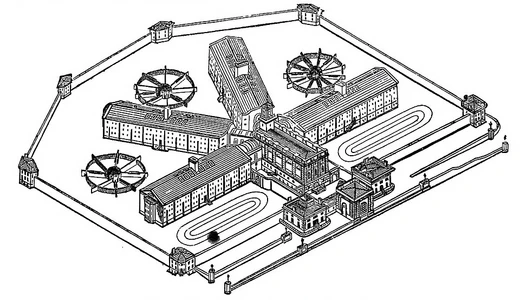
Incarceration
Restraint of liberty, lawful or not, across history and regions.
Imprisonment, also called incarceration, involves restricting someone’s freedom for any reason—whether done legally by the government or illegally by an individual (the latter being false imprisonment). It doesn’t require a locked cell; any use or show of force, like handcuffing someone, can constitute imprisonment, even in a public street. A word or touch from a proper officer can make someone a prisoner anywhere. Still, the common understanding of imprisonment is confinement against one’s will in a prison set up by law. Men are imprisoned at higher rates than women.
Despite reforms aimed at improving prison conditions for human rights reasons, the practice of imprisonment itself and the length of sentences have largely avoided human rights scrutiny, even though evidence shows it causes harm similar to torture and ill-treatment. Prison abolition remains a fringe idea, not mainstream, even amid criticism of mass incarceration in the United States and the defund the police movement.
**History**
**Africa** Before colonization, sub-Saharan Africa used imprisonment mainly for pretrial detention, to secure compensation, or as a last resort—not as punishment, except in the Songhai Empire (1464–1591) and during the Atlantic slave trade. Under colonial rule, prisons became a source of labor and a tool of suppression. This use continues today.
**Australia** Incarceration in Australia began with colonization. Scholar Thalia Anthony notes that the settler colonial state has used carceral tactics—containment and segregation—against Aboriginal Australians since the first arrivals, whether for Christian, civilizing, protectionist, welfare, or penal reasons. Settlers created courts and passed laws without Indigenous consent, claiming authority over them and their land. When Indigenous people challenged these laws, they were imprisoned.
**England and Wales** In English law, imprisonment means restricting a person’s liberty. The 17th-century book *Termes de la Ley* defines it as: “the restraint of a man's liberty, whether it be in the open field, or in the stocks, or in the cage in the streets or in a man's own house, as well as in the common gaols; and in all the places the party so restrained is said to be a prisoner so long as he hath not his liberty freely to go at all times to all places whither he will without bail or mainprise or otherwise.” Imprisonment without legal cause is the tort of false imprisonment. In England and Wales, a much larger share of the Black population is imprisoned than of the white population.
**Release** When prisoners finish their sentence, begin probation, or receive compassionate release, they are no longer considered prisoners and are freed. Prisoners of war may be released when hostilities end or through an exchange. Those serving full-life or indefinite sentences may never be released. Released prisoners can face psychiatric disorders, criminalized behaviors, and trouble meeting basic needs. Some serious offenders (those convicted of felonies or indictable offenses) face post-release restrictions, such as bans on buying firearms or exclusion from jury duty. Authorities may provide post-release resources. Factors studied for their effect on recidivism include family and other relationships, employment, housing, and the ability to quit drug use.
- definition
- Restraint of a person's liberty
- forms
- Includes handcuffs, open street, or prison
- false_imprisonment
- Imprisonment without lawful cause
- gender_imbalance
- Males incarcerated more than females
- historical_use_in_Africa
- Pre-colonial: pre-trial detention, compensation, last resort; colonial: labor and suppression
- historical_use_in_Australia
- Introduced through colonization, used against Aboriginal Australians
- release_issues
- Psychiatric disorders, criminalized behaviors, access to basic needs
Lore & Background
In English law, imprisonment is defined as the restraint of a man's liberty, whether in the open field, in the stocks, in the street, in one's own house, or in common gaols. The 17th-century book Termes de la Ley states that a person so restrained is a prisoner so long as they cannot freely go where they will without bail or mainprise. Imprisonment without lawful cause is a tort called false imprisonment. In England and Wales, a much larger proportion of the black population is imprisoned than of the white.
Reader's Guide
Imprisonment has been used historically in varied contexts. In sub-Saharan Africa before colonization, it was employed for pre-trial detention, to secure compensation, and as a last resort, but not generally as punishment, except in the Songhai Empire and in connection with the Atlantic slave trade. During the colonial period, imprisonment provided a source of labor and a means of suppression. In Australia, incarceration was introduced through colonization, and settler colonial states used carceral tactics of containment and segregation against Aboriginal Australians from the start, for Christian, civilizing, protectionist, welfare, or penal purposes. When Indigenous peoples challenged settler laws, they were imprisoned. Although reforms have targeted conditions of imprisonment on human rights grounds, imprisonment itself and sentence lengths have largely escaped such scrutiny despite evidence of harm similar to recognized ill-treatment and torture. Prison abolition is a growing movement but not mainstream, despite criticism of mass incarceration in the United States and the defund the police movement.
Did You Know?
- Imprisonment can occur in the open street, not only in a prison with bolts and bars.
- In the Songhai Empire, imprisonment was used as punishment, unlike most pre-colonial sub-Saharan Africa.
- In England and Wales, a much larger proportion of the black population is imprisoned than of the white.
- Released prisoners may suffer from psychiatric disorders, criminalized behaviors, and issues accessing basic needs.
Scale and Institutional Breadth of U.S. Incarceration
The United States reached its peak incarceration level in 2008, a year when more than one in every hundred adults was held in a prison or jail. At that moment, the nation's rate stood as the highest anywhere on Earth, a distinction it has since lost. The total count of those behind bars is drawn from a comprehensive tally that spans state prisons, federal facilities, and local jails, capturing both sentenced and unsentenced individuals. Data for these figures originates from the United States Department of Justice and other governmental sources. Beyond the three main institutional tiers, the broader picture also includes youth detention facilities, Indian country institutions, civil commitment centers, forensic psychiatric units, immigration detention, and military confinement. Each of these categories contributes to the overall count, and nationwide totals are compiled at the end of every data table. The sheer breadth of these categories underscores that the American correctional system extends far beyond the traditional prison walls most people picture.
International Comparisons and Relative Standing
When the United States' overall incarceration rate is set alongside those of other developed nations, the gap becomes immediately apparent. The United States held the title of the world's highest incarceration rate in 2008, but that record has since been overtaken. Even so, the American number remains several times higher than any of the peer nations listed above.
Female Incarceration: Domestic and Global Context
Women make up a small but significant share of the U.S. incarcerated population, and the United States stands out globally for its female imprisonment numbers. The data consistently show that while women represent a minority of the total behind-bars population, the absolute numbers in the U.S. dwarf those of any other single nation.
Racial Dimensions and Broader Systemic Context
The racial dimension of American mass incarceration has drawn sustained scholarly and public attention. The broader data infrastructure that tracks incarceration by state, territory, and institution type provides the raw material for examining these disparities in detail. Related topics that intersect with this racial analysis include the demographics of the U.S. population, the intersection of race with drug enforcement policy, youth incarceration, and the so-called school-to-prison pipeline. The correctional supervision data, which extends beyond prison walls to include probation and parole populations, adds another layer to understanding how the justice system touches communities at different rates. Together, these datasets and the scholarly commentary built upon them paint a picture of a system whose impact is distributed unevenly across racial lines.
Frequently Asked Questions
What is Incarceration in the Crime & Justice canon?
Incarceration is defined as the restraint of a person's liberty for any reason, whether carried out by a government body or by an individual acting without official authority. It is not limited to a walled prison; any lawful or unlawful use of force to hold someone against their will qualifies.
What forms does Incarceration take beyond a traditional prison?
The canon specifies that Incarceration can involve handcuffs, confinement in an open street, or placement in a lawfully designated prison. The key element is the restriction of freedom rather than the physical structure surrounding the person.
How is false imprisonment distinguished from lawful Incarceration?
False imprisonment occurs when a person's liberty is restrained without any lawful cause or authority. It can happen anywhere, even on a public street, and is treated as a distinct wrongdoing separate from authorized confinement.
What does the canon say about gender imbalances in Incarceration?
The source material notes that males are imprisoned at proportionately higher rates than females. This disparity is presented as a recurring pattern across the Crime & Justice entries.
How does the canon describe historical Incarceration in Africa and Australia?
In pre-colonial Africa, confinement was used for pre-trial detention, as a form of compensation, and as a last resort, while colonial powers repurposed it for forced labor and suppression. In Australia, the system was introduced by colonizers and directed against Aboriginal peoples.
More in Crime & Justice 1-24
Spotted an error? Know more?
This is a living reference — every entry is fact-audited, and reader corrections feed straight into our audit queue. Suggest an edit · See this site's audit record