Prison
A state-authorized facility for imprisoning individuals as punishment or pre-trial detention.
A prison—also called a jail, gaol, penitentiary, detention center, correction center, correctional facility, or remand center—is a place where the state holds people, typically as punishment for crimes. These facilities have two main jobs in the criminal-justice system: keeping people who are charged with crimes until their trial, and locking up those who have pleaded guilty or been convicted to serve their sentences. Authoritarian regimes sometimes misuse prisons for political repression, detaining perceived opponents without fair trials or due process, which breaks most international laws on justice. During war, countries involved in conflict or neutral nations may hold prisoners of war or other detainees in military prisons or prisoner-of-war camps. States can also imprison civilians, sometimes in large groups, in internment camps.
The words used for prisons vary by country and legal system. In Australia, "gaol," "jail," and "prison" are all common; "gaol" was once official, and many old gaols are now tourist sites like Maitland Gaol. Officially, "correctional centre" is used for most prisons in New South Wales and Queensland, while other states and territories use different names. "Prison" is official for some facilities in South Australia, Victoria, and Western Australia. Youth prisons are called "youth correctional facilities" or "youth detention centres," depending on the jurisdiction, and those held on remand without bail go to remand centres. In Canada, people commonly say "jail" or "prison," but official names use "facility," "correctional centre," "penitentiary," or "institution," though some places keep the historical "jail." New Zealanders also use "jail" and "prison" in speech, while official terms include "correctional facility." In Papua New Guinea, "prison" is official, but "jail" is more common and widely understood. In the UK and Ireland, the modern official term is "prison" (like HM Prison Barlinnie); "gaol" is now obsolete in speech but appears in older texts and legal contexts. The Gaols Act 1823 distinguished between gaols and houses of correction. Houses of correction were created by the Poor Relief Act 1601 in England and Wales to send the "idle poor" and vagrants for hard labor. Later laws added punishment for minor crimes after summary jurisdiction and pre-trial detention. The poor-relief function was later taken over by workhouses and then general public assistance. In American English, "prison" and "jail" have distinct meanings, though casual speech sometimes blurs the line, and official names vary by state. A "jail" holds people for short periods (like under a year) or for pre-trial detention and is usually run by local government, typically the county sheriff. A "prison" or "penitentiary" holds people for long periods (many years) and is run by state or federal government; after conviction, a sentenced person is usually sent to prison.
The use of prisons goes back to the rise of the state as a form of social organization. Some Ancient Greek philosophers, including Plato, started thinking about using punishment to reform offenders rather than just for revenge. Imprisonment was often used for people who couldn't pay fines, but since poor Athenians couldn't pay, they faced indefinite jail time, so time limits were eventually set. The prison in ancient Athens was called the desmoterion, or "the place of chains." The Romans were among the first to use prisons as punishment, not just for holding people. They used existing structures like metal cages, basements of public buildings, and quarries. One famous Roman prison was the Mamertine Prison, built around 640 B.C. by Ancus Marcius. It was in a sewer system under ancient Rome, with dungeons where prisoners lived in squalid conditions contaminated by human waste. Forced labor on public works was also common, and many citizens were sentenced to slavery in ergastula—primitive prisons where unruly slaves were chained to workbenches and did hard labor. Prisons existed not just in Rome but across the Roman Empire, though there was no regulated system. In medieval Songhai, trial results could lead to confiscation of goods or imprisonment, as various prisons existed in the empire. During the Middle Ages in Europe, castles, fortresses, and public building basements were used as makeshift prisons. The ability to imprison citizens gave officials an air of legitimacy and showed who held power. Another common punishment was galley slavery, where prisoners were chained together in ship bottoms and forced to row on naval or merchant vessels.
- field
- Criminal justice and penology
- known_for
- Facility for imprisonment under state authority, punishment, and pre-trial detention
- types
- Jail, prison, penitentiary, correctional centre, remand centre, youth detention centre
- functions
- Pre-trial detention and post-conviction confinement
- historical_origins
- Ancient Greece and Rome, with early prisons like the Mamertine Prison
Lore & Background
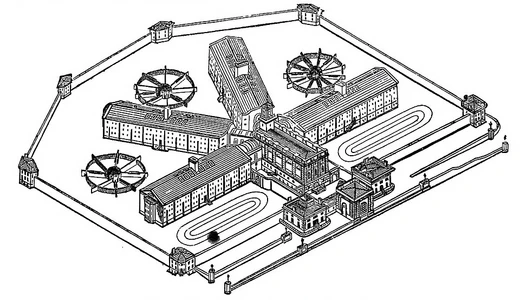
From the late 17th century and during the 18th century, popular resistance to public execution and torture became more widespread both in Europe and in the United States. Rulers developed systems of mass incarceration, often with hard labor, as a solution. The prison reform movement that arose was influenced by two contradictory philosophies: one based on Enlightenment utilitarianism and deterrence theory, and the other based on religious ideas of rehabilitation and moral reform. The concept of the modern prison as a highly regimented total institution was imported to Europe in the early 19th-century from America.
Reader's Guide
Prisons are a central institution in modern criminal-justice systems, serving both to detain individuals awaiting trial and to confine those convicted of crimes. Their significance extends beyond mere punishment, as they have historically been used for political repression, detention of prisoners of war, and internment of civilians. The terminology and structure of prisons vary widely by jurisdiction, as seen in Australia, Canada, New Zealand, the United States, and the United Kingdom, where distinctions between 'jail' and 'prison' often reflect differences in length of stay and level of government operation. The historical development of prisons reflects a shift from physical punishment and public shaming toward incarceration as a primary penalty, influenced by Enlightenment ideas of deterrence and religious notions of moral reform. Michel Foucault's work has been pivotal in analyzing how prisons function as part of broader social systems of discipline and power. Prisons remain a subject of debate regarding their effectiveness in rehabilitation, deterrence, and the fair administration of justice, especially in contexts where they are used to suppress political dissent without due process.
Did You Know?
- The prison in ancient Athens was known as the desmoterion, meaning 'the place of chains'.
- In the United States, a 'jail' typically holds people for shorter periods (less than a year) or for pre-trial detention and is operated by local government, while a 'prison' holds people for longer periods and is operate
- The concept of the modern prison as a highly regimented total institution was imported to Europe in the early 19th-century from America.
Frequently Asked Questions
What is a prison?
A prison is a state-run facility designed to hold people who have been charged with or convicted of crimes. It operates under governmental authority and serves as the primary site for both pre-trial holding and post-conviction punishment.
What are the two core functions of a prison within the justice system?
Prisons primarily serve to detain individuals awaiting trial and to confine those who have been convicted or pleaded guilty so they can complete their sentences. These two roles—pre-trial detention and post-conviction confinement—form the backbone of how prisons operate in criminal justice.
What are the different types or names for prisons?
Depending on jurisdiction and purpose, these facilities go by names such as jail, gaol, penitentiary, correctional centre, remand centre, or youth detention centre. Each label often reflects a specific role, such as short-term holding versus long-term incarceration.
Where did the concept of the prison originate historically?
The idea of dedicated imprisonment facilities traces back to ancient Greece and Rome. One of the earliest known examples is the Mamertine Prison, which dates to the Roman era.
Can prisons be used for purposes other than standard criminal punishment?
Yes. Authoritarian regimes have historically employed prisons as instruments of political repression against dissenters. Additionally, during wartime, belligerent nations may use detention facilities to hold captured enemy combatants.
More in Crime & Justice 1-24
Spotted an error? Know more?
This is a living reference — every entry is fact-audited, and reader corrections feed straight into our audit queue. Suggest an edit · See this site's audit record