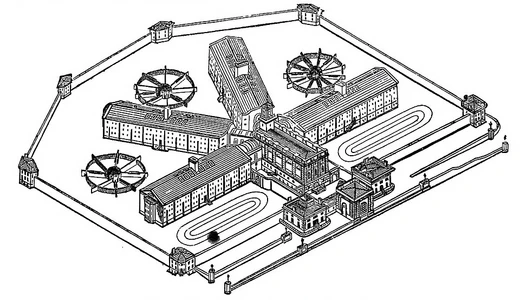
Prison
A state-authorized facility for imprisoning individuals as punishment or pre-trial detention.

A prison, also known as a jail, gaol, penitentiary, detention center, correction center, correctional facility, or remand center, is a facility where people are imprisoned under the authority of the state, usually as punishment for various crimes. Prisons serve two primary functions within the criminal-justice system: holding people charged with crimes while they await trial, and confining those who have pleaded guilty or been convicted to serve out their sentences. Prisons can also be used as a tool for political repression by authoritarian regimes, and in times of war, belligerents may detain prisoners of war in military prisons or prisoner-of-war camps.
- field
- Criminal justice and penology
- known_for
- Facility for imprisonment under state authority, punishment, and pre-trial detention
- types
- Jail, prison, penitentiary, correctional centre, remand centre, youth detention centre
- functions
- Pre-trial detention and post-conviction confinement
- historical_origins
- Ancient Greece and Rome, with early prisons like the Mamertine Prison
Lore & Background
From the late 17th century and during the 18th century, popular resistance to public execution and torture became more widespread both in Europe and in the United States. Rulers developed systems of mass incarceration, often with hard labor, as a solution. The prison reform movement that arose was influenced by two contradictory philosophies: one based on Enlightenment utilitarianism and deterrence theory, and the other based on religious ideas of rehabilitation and moral reform. The concept of the modern prison as a highly regimented total institution was imported to Europe in the early 19th-century from America.
Reader's Guide
Prisons are a central institution in modern criminal-justice systems, serving both to detain individuals awaiting trial and to confine those convicted of crimes. Their significance extends beyond mere punishment, as they have historically been used for political repression, detention of prisoners of war, and internment of civilians. The terminology and structure of prisons vary widely by jurisdiction, as seen in Australia, Canada, New Zealand, the United States, and the United Kingdom, where distinctions between 'jail' and 'prison' often reflect differences in length of stay and level of government operation. The historical development of prisons reflects a shift from physical punishment and public shaming toward incarceration as a primary penalty, influenced by Enlightenment ideas of deterrence and religious notions of moral reform. Michel Foucault's work has been pivotal in analyzing how prisons function as part of broader social systems of discipline and power. Prisons remain a subject of debate regarding their effectiveness in rehabilitation, deterrence, and the fair administration of justice, especially in contexts where they are used to suppress political dissent without due process.
Did You Know?
- The prison in ancient Athens was known as the desmoterion, meaning 'the place of chains'.
- In the United States, a 'jail' typically holds people for shorter periods (less than a year) or for pre-trial detention and is operated by local government, while a 'prison' holds people for longer periods and is operate
- The concept of the modern prison as a highly regimented total institution was imported to Europe in the early 19th-century from America.
Frequently Asked Questions
What is a prison?
A prison is a state-run facility designed to hold people who have been charged with or convicted of crimes. It operates under governmental authority and serves as the primary site for both pre-trial holding and post-conviction punishment.
What are the two core functions of a prison within the justice system?
Prisons primarily serve to detain individuals awaiting trial and to confine those who have been convicted or pleaded guilty so they can complete their sentences. These two roles—pre-trial detention and post-conviction confinement—form the backbone of how prisons operate in criminal justice.
What are the different types or names for prisons?
Depending on jurisdiction and purpose, these facilities go by names such as jail, gaol, penitentiary, correctional centre, remand centre, or youth detention centre. Each label often reflects a specific role, such as short-term holding versus long-term incarceration.
Where did the concept of the prison originate historically?
The idea of dedicated imprisonment facilities traces back to ancient Greece and Rome. One of the earliest known examples is the Mamertine Prison, which dates to the Roman era.
Can prisons be used for purposes other than standard criminal punishment?
Yes. Authoritarian regimes have historically employed prisons as instruments of political repression against dissenters. Additionally, during wartime, belligerent nations may use detention facilities to hold captured enemy combatants.
More in Crime & Justice 25-40
Elsewhere in the Crime & Justice universe
Spotted an error? Know more?
This is a living reference — every entry is fact-audited, and reader corrections feed straight into our audit queue. Suggest an edit · See this site's audit record